
Plan of studies
Academic calendar
The academic year runs from September to May or June, depending on your programme. The year includes several vacation periods, including a two-week break at the end of December (Christmas and New Year).
The two semesters are separated by a short break following final examinations at the end of the first semester. The summer vacation lasts over two months and always includes July and August.
LMD system
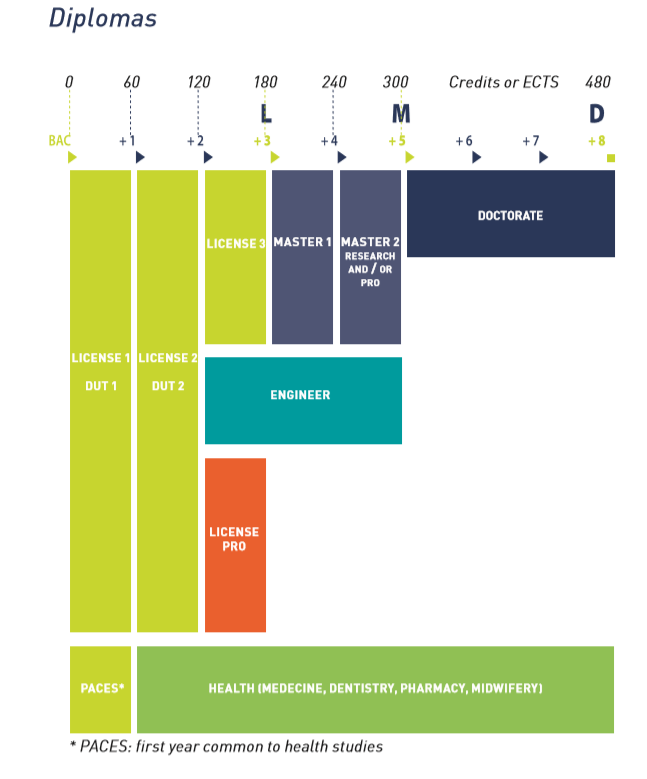
As part of the harmonisation of European higher education, university study programmes are organised around three degrees:
- Licence - undergraduate degree (L)
- Master (M)
- Doctorate (D)
The advantages of this system include :
- recognition and equivalence across Europe
student mobility
better recognition of degrees in the labour market
Organisation of studies
Semester system- The Licence is divided into six semesters
- The Master is organised over four semesters
Credits can be accumulated and transferred
Each semester is assigned 30 credits, or ECTS (European Credit Transfer System), which are recognised in many European countries:- Licence: six semesters validated = 180 credits
- Master: four semesters validated = 300 credits
Course Unit system (Unités d'Enseignement - UE)
The system consists of course units. Each UE has a value defined in ECTS credits and corresponds to the number of hours of study (lectures, tutorials, practical work, personal projects) that students must complete to obtain the UE. A full academic year represents 60 credits, or 30 credits per semester.Recognition of International Qualifications
No predetermined set of equivalences between French and foreign degrees is officially recognised in France. Each institution is free to set its own admission criteria and make its own admission decisions based on each applicant's background and the requirements of the programme to which they are applying.
This flexibility allows French institutions to compose well-qualified and well-balanced student cohorts, whilst also protecting the integrity and reputation of the education offered.
Classes
- Large lecture classes
- Seminars, tutorials and practical classes
In seminars, tutorials and practical classes, small groups of students meet to apply or explore in greater detail the material covered in lectures. Attendance at these sessions is mandatory, whereas attendance at lectures is not.
In career-oriented programmes offered at universities, internships and practical training are required in addition to small-group seminars.